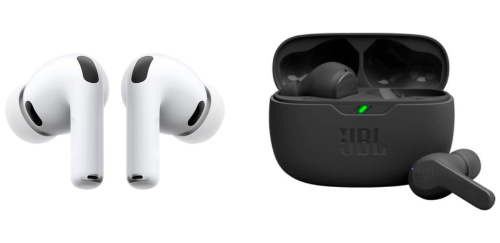
AirPods Pro 3 & JBL Vibe Beam Wireless share many similarities, but there are also important differences, such as quality, performance, features, design, and connectivity. If you want the best one between them, I Would recommend the Apple AirPods Pro 3 rather than the JBL Vibe Beam.
[lwptoc]
Why Do I Recommend The AirPods Pro 3?
- The AirPods Pro 3 features the Apple H2 chip for real-time audio processing, adaptive EQ, and efficient power management for smoother performance and consistent sound quality, whereas the JBL Vibe Beam uses a standard Bluetooth chipset without dedicated audio processing.
- AirPods Pro 3 supports personalized spatial audio with head tracking for a 3D listening experience that adjusts direction based on head movement, while the JBL Vibe Beam does not support spatial audio or head tracking.
- It includes adaptive active noise cancellation for dynamically adjusting noise reduction based on surrounding environment conditions, whereas the JBL Vibe Beam includes standard noise cancellation without real-time adaptation.
- The AirPods Pro 3 comes with adaptive transparency mode for automatically reducing sudden loud external sounds while keeping ambient awareness active, while the JBL Vibe Beam uses a fixed ambient aware mode.
- AirPods Pro 3 features U2 chip in the charging case for precision finding with directional tracking and distance estimation through compatible devices, whereas the JBL Vibe Beam does not include any tracking chip.
- It includes MagSafe and Apple Watch charging compatibility for flexible wireless charging options across multiple Apple devices, while the JBL Vibe Beam supports standard Qi wireless charging only.
- The AirPods Pro 3 features advanced beamforming microphones with computational audio processing for clearer voice capture and reduced background noise during calls, whereas the JBL Vibe Beam uses a standard microphone system with basic noise handling.
- AirPods Pro 3 supports automatic device switching across Apple devices for seamless transitions between iPhone, iPad, and Mac without manual reconnection, whereas the JBL Vibe Beam lacks automatic switching.
Maybe the JBL Vibe Beam can make you comfortable because it’s a little bit cheaper than the AirPods Pro 3. But you have to compromise all the above-mentioned features. Now the Decision is Yours. I hope it was helpful to choose the right one.
Side-by-Side Comparison
| Feature | AirPods Pro 3 | JBL Vibe Beam |
| Chipset | Apple H2 chip | Standard Bluetooth SoC |
| Bluetooth Version | Bluetooth 5.3 | Bluetooth 5.2 |
| Audio Processing | Adaptive audio processing | No adaptive processing |
| Spatial Audio | Personalized spatial audio + head tracking | Not supported |
| Active Noise Cancellation | Adaptive ANC | Standard ANC |
| Transparency Mode | Adaptive Transparency | Ambient Aware |
| Driver Type | Custom high-excursion driver | Dynamic driver |
| Charging Port | USB-C + MagSafe + Apple Watch charger | USB-C |
| Wireless Charging | MagSafe + Qi | Qi |
| Water Resistance | IP57 | IP54 |
| Ear Tip Sizes | 5 sizes | 3 sizes |
| Sensors | Heart rate + accelerometer + skin detect | Basic touch + mic |
| Health Tracking | Heart rate monitoring | Not supported |
| UWB Chip | U2 chip in case | Not available |
| Case Features | Speaker + Precision Finding | No speaker / tracking |
| Multipoint | Automatic Apple switching | Limited multipoint |
| Control Type | Touch + swipe gestures | Touch only |
| Call Microphones | Beamforming + AI noise reduction | Standard mic array |
| Price | Check AirPods Pro 3 Price | Check JBL Vibe Beam Price |
What Common Both Can Do?
- True Wireless Design: Both earbuds use a completely wire-free design, eliminating cables between the earbuds and the device. This makes them convenient for everyday use, commuting, and workouts.
- In-Ear Fit: Each model features an in-ear design that sits securely inside the ear canal. This helps improve stability and contributes to passive noise isolation during use.
- Silicone Ear Tips: Both earbuds include silicone ear tips to create a seal inside the ear. This improves comfort over long listening sessions and helps enhance sound quality.
- Bluetooth Connectivity: Both devices connect wirelessly using Bluetooth technology. This ensures compatibility with smartphones, tablets, and laptops across different platforms.
- Touch Controls: Each model includes touch-sensitive controls on the earbuds. This allows users to manage playback, calls, and other functions without reaching for their device.
- Built-in Microphones: Both earbuds come with integrated microphones for voice pickup. This enables calling, voice commands, and communication during meetings or online calls.
- Voice Assistant Support: Each model supports voice assistant integration. This allows users to control functions, check information, or send messages using voice commands.
- Charging Case Included: Both earbuds come with a portable charging case. This case stores the earbuds and provides additional battery power when needed.
- USB-C Charging: Each model supports USB-C charging for the case. This provides a modern, widely compatible charging standard for faster and easier power delivery.
- Wireless Charging: Both earbuds support wireless charging for the case. This allows users to charge without plugging in cables, adding convenience to daily use.
- Stereo Audio Output: Each model delivers stereo sound with separate left and right channels. This creates a more immersive and directional listening experience.
- Hands-Free Calling: Both earbuds support hands-free calling functionality. This allows users to take calls without holding their phone, improving multitasking.
- Noise Isolation: Each model provides passive noise isolation through its in-ear seal. This helps reduce external noise and enhances audio clarity.
- Ambient Sound Mode: Both earbuds include an ambient or transparency listening mode. This allows users to hear surrounding sounds without removing the earbuds.
- Mobile App Support: Each model is supported by a companion mobile app. This enables users to adjust settings, customize controls, and update firmware.
- Firmware Updates: Both earbuds support firmware updates via software. This helps improve performance, fix issues, and add new features over time.
- Auto Pairing: Each model supports automatic pairing with previously connected devices. This speeds up reconnection and improves overall user experience.
- LED Charging Indicator: Both cases include LED indicators to show charging status. This provides quick visual feedback about battery levels and charging progress.
Common Features
| Feature | AirPods Pro 3 | JBL Vibe Beam |
| True Wireless Design | Yes | Yes |
| In-Ear Fit | Yes | Yes |
| Silicone Ear Tips | Yes | Yes |
| Bluetooth Connectivity | Yes | Yes |
| Touch Controls | Yes | Yes |
| Built-in Microphones | Yes | Yes |
| Voice Assistant Support | Yes | Yes |
| Charging Case Included | Yes | Yes |
| USB-C Charging | Yes | Yes |
| Wireless Charging | Yes | Yes |
| Stereo Audio Output | Yes | Yes |
| Hands-Free Calling | Yes | Yes |
| Noise Isolation | Yes | Yes |
| Ambient Sound Mode | Yes | Yes |
| Mobile App Support | Yes | Yes |
| Firmware Updates | Yes | Yes |
| Auto Pairing | Yes | Yes |
| LED Charging Indicator | Yes | Yes |
| Price | Check AirPods Pro 3 Price | Check JBL Vibe Beam Price |